

Pacific Sisters
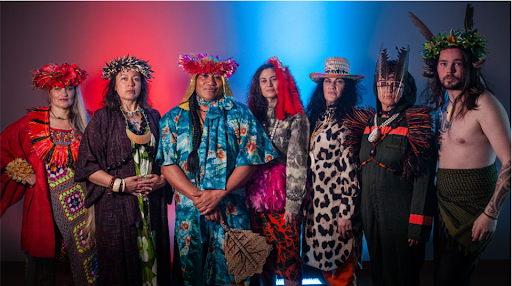
The Pacific Sisters is a Tāgata Moana art collective that emerged from the fringes of mainstream arts and culture in New Zealand, in 1992. They are now celebrated for their multi-disciplinary practice that blends Moana heritage art and contemporary forms to create fashion activism. Through ceremony, art, adornment and performance, they embrace and assert their urban Māori, Pacific, and Queer identities, unique to Aotearoa (New Zealand). Pacific Sisters advocate for the environment, Indigenous, POC and Queer rights and body sovereignty. The collective is an active and influential part of the wider Moana arts community, nurturing and mentoring younger artists as well as inspiring and supporting each other’s individual art practices. Renowned for their philosophical or ‘kaupapa-driven’ frock ethos, which envisions clothing less as adornment than as a statement of power, each Pacific Sister aitu (avatar) has a unique story.
“Born into the world are three new aitu (avatars) that embody the kaupapa (philosophy) of Pacific Sisters’ fashion activist works:
1): MuruMoa, named for one of the sites of the French nuclear tests conducted from 1966 to 1996, guards what is left of a post-nuclear world, protecting motu (lands), moana (oceans) and tagata (people).
2): Sup’ia Suga, believer in pono (honesty), manaakitanga (kindness and generosity) and ataahuatanga (supa-fabulous), is described as ‘part Wonder Woman and part Superman, and all girl power.’ Encouraging each of us to take responsibility for our own actions, Sup’ia Suga is here to save the day.
3): Tapu Tinana embodies Nephi Tupaea’s personal journey back to her whānau (family group), and Kaitiaki with a K wears an obsidian-like videotape cloak in lieu of natural fibres. An obsolete material, the videotape ripples as if alive.”
City
Country
Region
Year of Creation
Featured Project

Resources
Cole, Mya. “How the Protest Art of the Pacific Sisters Forged a Space in a City of Outsiders.” VICE, 22 Feb. 2019, https://www.vice.com/en/article/how-the-protest-art-of-the-pacific-sisters-forged-a-space-in-a-city-of-outsiders/.
Gordon‑Smith, Ioana. “From the Margins to the Mainstream: Pacific Sisters at Te Papa.” Pantograph Punch, 18 Apr. 2018, http://pantograph-punch.com/post/pacific-sisters.
Harris, Kate. “Pacific Sisters: Fashion Activists in the Diaspora.” Art History Society, 14 Mar. 2019, https://arthistorysociety.org/essays/pacific-sisters-fashion-activists-diaspora.
Rault, Jacqueline Charles. “More than Simply Traditional – The Pacific Sisters.” Pacific Arts, vol. 10, no. 2, 2010, pp. 5–15. https://www.jstor.org/stable/23412153.
Raymond, Rosanna. “Getting Specific: Fashion Activism in Auckland during the 1990s: A Visual Essay.” In Clothing the Pacific, edited by Chloë Colchester, pp. 193–208. Berg, 2003.
Vercoe, Caroline, and Robert Leonard. “Pacific Sisters: Doing It for Themselves.” ArtAsiaPacific, no. 14, 1997, pp. 43–45. http://robertleonard.org/pacific-sisters-doing-it-for-themselves/.
Archive:
Auckland Museum. “Pacific Sisters.” Auckland Museum, https://www.aucklandmuseum.com/visit/galleries/ground-floor/tamaki-herenga-waka/pacific-sisters.
Biennale of Sydney. “Pacific Sisters.” Biennale of Sydney, https://www.biennaleofsydney.art/participants/pacific-sisters/.
Hawai‘i Contemporary. “Pacific Sisters [Exhibition].” Hawai‘i Triennial 2022, 2022, https://hawaiicontemporary.org/artist-pacific-sisters.
Museum of New Zealand Te Papa Tongarewa. “Pacific Sisters: Fashion Activists.” Pacific Sisters: He Toa Tāera [Exhibition], 17 Mar.–15 July 2018, https://www.tepapa.govt.nz/about/past-exhibitions/pacific-sisters-fashion-activists.
Audio‑Visual:
Auckland War Memorial Museum. “Pacific Sisters Ē Tu // PS \ AITU – Pacific Sisters – Auckland Museum.” YouTube, Nov. 2021, https://www.youtube.com/watch?v=1zt1Tuws73o.
Museum of New Zealand Te Papa Tongarewa. “Pacific Sisters create ‘Tāulaolevai: Keeper of the Water (Tuna).’” YouTube, 10 May 2018, www.youtube.com/watch?v=09ips64rhK8.
New Zealand Fashion Museum. “Pacific Sisters Ē Tu // PS \ AITU.” YouTube, Nov. 2022, https://www.youtube.com/watch?v=l35TRIbwjeI.
New Zealand Fashion Museum. “Pacific Sisters: In Conversation and Fluffy Workshop.” YouTube, Nov. 2022, https://www.youtube.com/watch?v=od5VcvWD444.
Salmon, Pākē. “Pacific Sisters Toi Art Gallery Opening – ActiVAtion Te Papa Museum 2018.” YouTube, 10 May 2018, https://www.youtube.com/watch?v=x0VQcxxneD4.
Tonga, Nina. “Pacific Sisters: Fashion Activists.” Interview by Kim Hill. Saturday Morning, RNZ, 3 Mar. 2018, https://www.radionz.co.nz/national/programmes/saturday/audio/2018634519/nina-tonga-pacific-sisters-fashion-activists.
More Information
IMPORTANT: Profile pages for all collectives are in permanent development and have been built using information in the public domain. They will be updated progressively and in dialogue with the organizations by the end of 2024. New features and sections will be included in 2025, like featured videos, and additional featured projects. Please contact us if you discover errors. For more information on mapping criteria and to submit your organization’s information to be potentially included in the database, visit this page